
The Edge - February 2021
Are we going to be a Zoom economy? Has COVID-19 changed things forever?
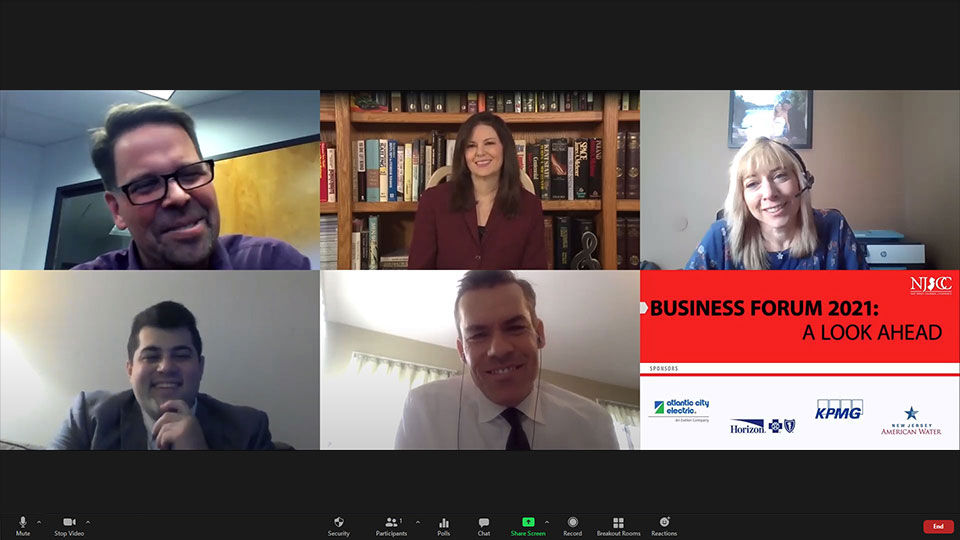
Getting people vaccinated, reopening the economy, coping with the shutdown and the post-COVID economy were topics discussed by five New Jersey business reporters during a Jan. 27 business forum hosted by the New Jersey Chamber of Commerce.
When the state economy fully reopens, it will be in position to thrive and it will look different, with more people working from home, more restaurants without dining rooms and more companies without a physical presence, the reporters said.
See below to read more about what was discussed at the forum, moderated by Tom Bergeron, owner and editor of ROI-NJ.
View full replay of the NJ Chamber's Business Roundtable 2021
Getting People Vaccinated
The state needs to reach its goal to vaccinate 70 percent of the adult population – or 4.7 million adults – in about six months in order to have confidence in reopening the economy, members of the panel agreed.
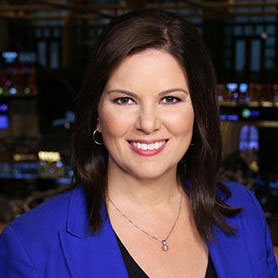 Rhonda Schaffler, Business Correspondent, NJ Spotlight News“Everyone wants to (get vaccinated) first,” said Rhonda Schaffler, business correspondent at NJ Spotlight News. “Every business wants to get their employees vaccinated.”
While the vaccine rollout hasn’t exactly been smooth, the hiccups are not unique to New Jersey, said Kurt Siegelin, evening news anchor at News 12 New Jersey. “We are in the middle of the pack among states, as terms of getting doses out,” he said. Between a shortage of supply, a massive demand and an unprecedented mission, “There is (only) so much the governor can do to get people vaccinated.”
Schaffler added another eventual wrinkle. “Not everyone wants to get vaccinated so what does that mean for employers?” There are unanswered questions: Can an employer require employees to get vaccinated? Will there be liability protections for businesses in the case someone claims that they acquired COVID-19 in the workplace. “Liability is going to be an issue,” Schaffler said.
When Will the Economy Reopen?
“Business operators need the economy to be open,” said Stacie Sherman, Deputy Managing Editor for U.S. Bureaus at Bloomberg News. “They need people out there buying their goods and going out to restaurants. Schools need to be open in order to get people back in the office.”
“The governor and politicians are waiting for critical mass with vaccinations to open the economy,” Sherman added. “In the meantime, tax cuts or tax credits may be next to help businesses manage and help businesses reopen.”
 Daniel Munoz, Staff Writer, Government/Economic Development, NJBIZDaniel Munoz, staff writer at NJBIZ, said, “As the weather gets warmer, restrictions will gradually be lifted, with indoor dining increasing incrementally. It won't happen overnight. It will be a matter of months.”
We can’t reasonably expect a hard date for reopening, Siegelin said. “I understand the frustration of business owners, but the virus is dictating the timetable, as is the rollout of the vaccine. It’s hard to give a date.”
However, “One of the big problems the governor has had is the messaging of the data,” Siegelin added. “People see the numbers but they don’t understand what the metrics are.” Where do the numbers need to get before the state moves to further reopen the economy?
“County-by-county is one way the state can potentially address reopening with some counties reopening where numbers are lower,” Schaffler said.
It will be interesting to see how quickly offices ramp up after the economy reopens, Schaffler added. “Employers don’t want to be among first to make the decision (to reopen) and be wrong,” she said. “There are a lot of hard decisions without much guidance.”
How Will This Year’s Gubernatorial Election Impact Reopening?
 Stacie Sherman, Deputy Managing Editor for U.S. Bureaus, Bloomberg News“The governor wants to campaign with the economy open and kids at school,” Sherman said. “He has a couple of months to do it. He will face pressure to get this done by campaign season.”
Coincidentally, it appears the reopening will work hand-in-hand with the governor's campaign schedule, Siegelin said.
“By mid-late spring, the caseloads, the hospitalizations and the vaccinations will allow the state to open the economy,” Siegelin predicted. “By August, vaccinations will be a bigger story than virus caseloads.”
Schaffler said: “I love that optimism and I hope that’s right.”
“When we get to campaign season, the question will be, ‘have businesses recovered,’” she added. “New Jersey’s unemployment rate is higher than the national average so the economic story right now is not a good one. At campaign time, if people haven’t found jobs, that will be part of the conversation. The election is going to come down to how people feel.”
How are Businesses Coping?
“Nationwide, business people don’t feel like they are getting a fair shake,” Siegelin said. “The first Paycheck Protection Program’s (forgivable) loans seemed to go to corporations, not small businesses. People are fed up with waiting and small businesses are looking for help.”
 Tom Bergeron, Owner and Editor, ROI-NJThe restaurant industry has been “clobbered” by this, Bergeron said. “There have been starts and stops. If they can’t have customers, then they are not surviving."
“The focus should be on small business because large corporations have more resources,” Schaffler added. “The second round of PPP (loans) is supposed to focus more on small businesses, and we will see what happens. Going forward, restaurants need grants, they need more money, whether its state or federal. The faster they get more help, the better it will be for them and their employees.”
With grants, forgivable loans and stimulus checks, “the economy is in suspended animation,” added Munoz, of NJBIZ. “We are paying people not to work and paying businesses to stay afloat. That’s not a long-term solution.”
There has been some good news. “We have done some stories over the last couple of weeks about new restaurants opening right now,” Siegelin said. “They have adjusted to this reality. They don’t have indoor seating. They are all delivery. They just believe in how good their food tastes. You see the adaptation of entrepreneurs, and you have to commend them.”
Schaffler agreed that the current conditions can be an “opportunity” for some small businesses. “Cost of capital will remain low. Rent is low. They know they can work at home,” she said.
Will the New Economy be a ‘Zoom Economy?’
The state’s demographics and its business culture are facing transformational changes in the wake of COVID-19.
Sherman, of Bloomberg News, threw out some questions to ponder: Will more people move from New York City to the New Jersey suburbs because they desire more space? Will more people move from New Jersey to lower-cost states like Florida because working in offices is no longer essential? Or will people want to live in cities where the cost of commuting is lower? Should New Jersey residents working from home be paying income taxes in their home state or the state where their business offices are located?
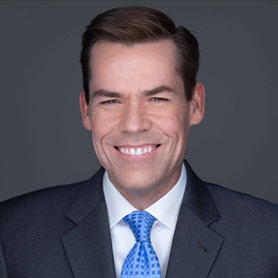 Kurt Siegelin, Evening News Anchor, News 12 New JerseySiegelin added more questions: What will the economy look like in ten years? Are we going to be a Zoom economy? Has COVID-19 changed things forever going forward? Will people opt to no longer commute every morning? What will commercial real estate look like a year from now? “It’s hard to predict,” Siegelin said. “We are at a transitional moment because of what has happened with COVID. There are a lot of calculations in this formula and it’s hard to see ahead, but I can tell you things will not be like they were a year ago.”
New Jersey is well-positioned for a rebound, Schaffler said. "New Jersey – with ports, highways and transportation hubs – has it all right now," she said. “We have had stealth growth in our warehousing industry. There are plenty of consumers here to buy your goods and services. And there is plenty to do in New Jersey. Those are the positives. The negatives are the cost of running a business in New Jersey. How will this play out? We'll see.”
Her expectation: “The economy will bounce back and be strong. Businesses will be entrepreneurial and inventive. But it will take the jobs longer to come back and we’ll continue to see disruption in the workforce for a while.”
Main Streets across New Jersey can benefit from more people working from home, Munoz said. “Once the economy opens, people will flock again to stores and restaurants,” he said. “People are ready to get out. The economy will eventually recover, it will look fundamentally different, perhaps with more people working from home.
“With all the pent-up demand for going out,” Munoz said, “we may have something like a ‘Roaring 20s’’ once we get COVID under control. People may be dressing up to go to the store.”
Once the state’s economy reopens, “The party is on,” Siegelin added. “There is not going to be a COVID reason, in the second half of this year, not to reopen, and for people not to go out. My one concern is people's own hesitancy in going out – about going to restaurants, going to stores and going to sports stadiums to watch a game,” he said. “It may all be open, but are people going to be concerned? How long will that take to overcome?”
View full replay of the NJ Chamber's Business Roundtable 2021